
Insight · how your company really decides
Organizational Design
Who decides, who delivers and who takes over, which meetings you need and who has which role: we reorganize this for your company, with your leadership team and along your daily work. If you want, we then set the result down in an organizational constitution.
Rather see first where things get stuck? Free Clarity Call
At a glance
- What it is
- a new way of organizing the processes where unclear responsibilities cost you most: who decides, who prepares, which meetings you need and how the roles fit together.
- Your effort
- four three-hour workshops with your leadership team, five in the Mid-Size option plus one conversation per division, around twelve to fifteen hours per person in total. On top of that come reading the drafts, two weeks of notes kept by the managing director, one contact person and documents you already have. Three to five processes get reorganized, not the whole company.
- Duration
- six to ten weeks.
- Price
- from €12,900, plus VAT where it applies. A Management Baseline from the past three months is credited in full.
- Opting out
- possible after the first workshop; you then pay a third of the price.
- Afterwards
- if you want, the organizational constitution to make the design binding.
How you notice it's time
- Topics go round several meetings before anyone decides. In the end a lot of it lands back with the managing director.
- Work waits at the handovers between departments, because nobody has settled who delivers and who takes over.
- Your company has grown, and its structure dates from a time when you had half as many people.
- A succession is coming up, and much of what applies in your company isn't written down anywhere.
- Software takes over parts of the work, and no role description says who is responsible for what afterwards.
What organizational design means in my work
The org chart shows who reports to whom. Organizational design goes further. It sets out how your company decides in daily work, who prepares, decides and checks in your key processes, which meetings that needs and how the roles fit together. The org chart sometimes changes along with it, and quite often it stays as it is.
Every company works by two sets of rules. One is written down in the rules of procedure, job descriptions and approval rules. The other has grown up beside it, as a shortcut, a list kept next to the system or an agreement everybody knows. A good design takes both seriously, because the unwritten rules usually appear where the written ones no longer fit the work.
How it works
- See where things get stuck. If there's no clear picture yet, the work starts with the Management Baseline. Your leadership team fills in a survey, and you see the pattern that is slowing your company down, compared with 458 organizations from the “Patterns of Mastery” study. If you already have that picture, we start right away.
- Choose. Your leadership team picks the three to five processes and handovers where unclear responsibilities cost the most. That's where the design starts, so that something changes in daily work within a few weeks. Before the first workshop we record the starting value of the measure for these processes, for example how many decisions end up with the managing director in two weeks.
- Draft. For each process you've chosen, I put options on the table: who decides, who prepares, which meeting is in charge and which role has to change for it. I prepare and facilitate. The weighing up is done by your leadership team.
- Decide. In the workshops your leadership team decides what applies from now on and in which order you introduce it. You end up with a twelve-month roadmap, with the smallest sensible step first.
- Check back. In the last workshop your leadership team already sets for each change who is accountable, when it starts and when it gets reviewed. Four weeks later we look together at what's in place and where people still work the old way. This follow-up is included in the price.
If your leadership team can't agree. Before weighing up the options, it sets the criteria for judging them. Without agreement, you go with the option nobody has a reasoned, serious objection to. If such an objection remains, the managing director decides, gives the reasons and sets a review date. Until then the solution runs as a trial.
What you have in hand at the end
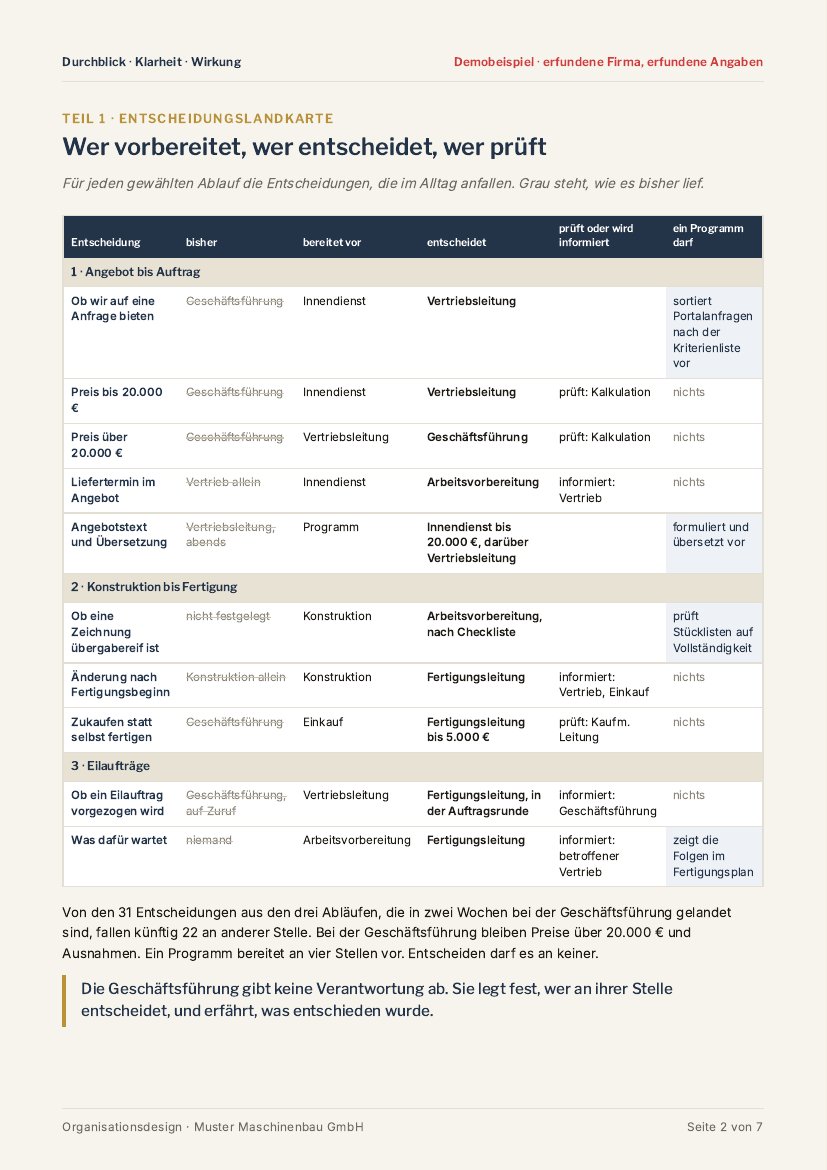
- A decision map for your most important processes: who prepares, who decides, who checks and what a program may take over.
- Roles and deputies: who has which role, who stands in and which knowledge so far depends on one single person.
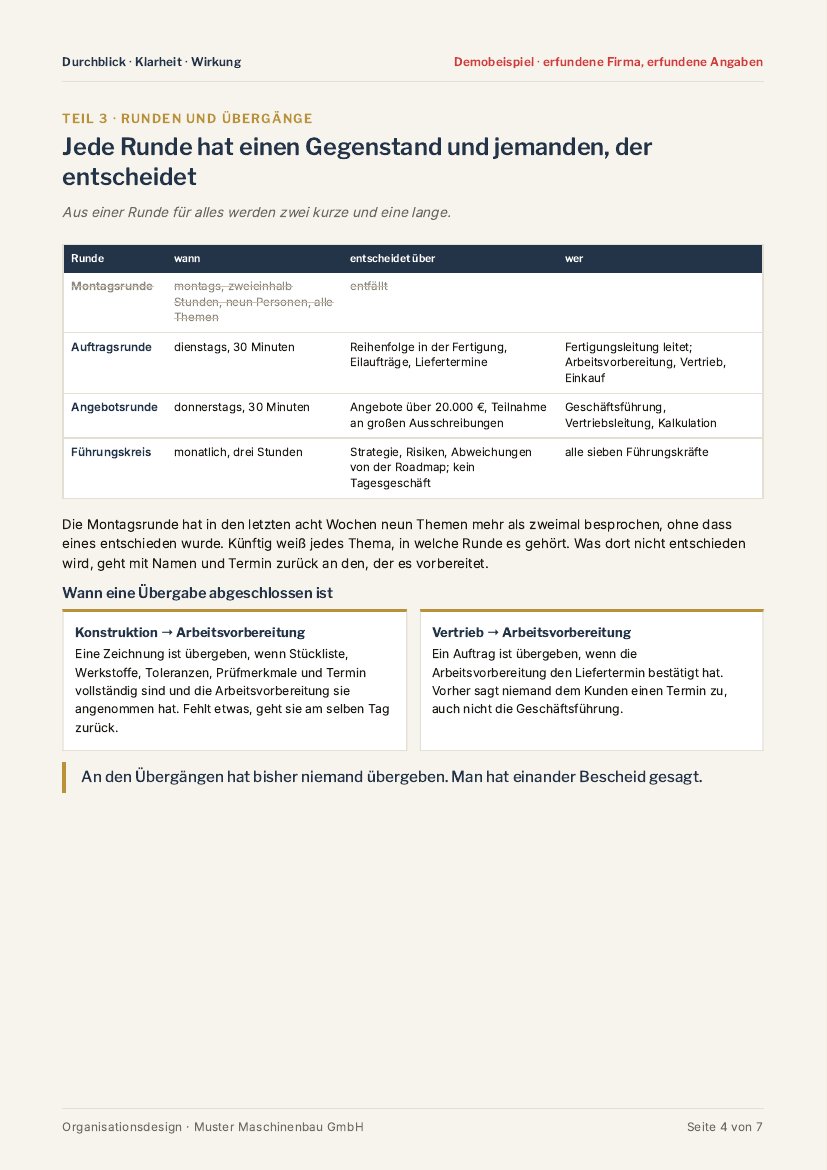
- Your meetings and handovers: which bodies and meetings you need, what gets decided there and who delivers and takes over at the interfaces.
- A check of goals, key figures and incentives against what you expect from your people in daily work.
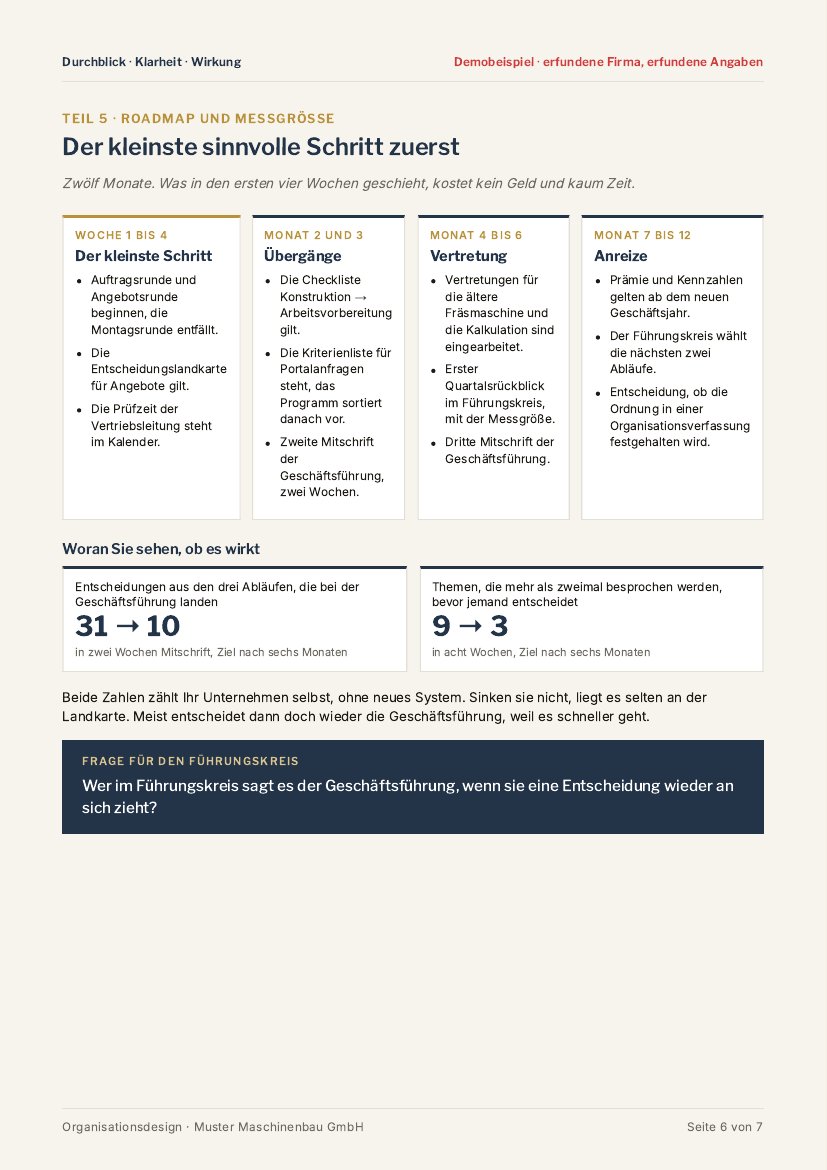
- A roadmap for twelve months and one measure that shows you whether daily work has actually changed.
An example with invented details shows what such a result looks like: three of seven pages from the result for a machine builder with about 120 employees, with decision map, meetings and roadmap (PDF in German).
When AI works alongside
Programs take over tasks that used to be part of a role. They pre-sort, score or suggest answers. A task can go to a system, but the role and its responsibility stay with a person. So for each process you've chosen, the design sets out what a program may prepare or do on its own and who stays responsible.
If you're introducing AI right now, that's often a good moment for a new design, because the division of work is shifting anyway. If AI isn't an issue for you today, this part stays small. Your design is still ready for the day a program takes over a task.
Over twelve months, with your AI list and the constitution: annual mandate →
Afterwards: the organizational constitution
A design describes how your company is going to work. The organizational constitution makes it binding. It records what still applies when two managers disagree, which few limits apply to everyone, the managing director included, and how these rules can be changed.
That way your design gets through the next conflict and the next change of leadership. The constitution builds on the design, so straight afterwards it costs €2,900 less, or €3,900 less with a works council or a multi-tier legal structure.
Prices
For companies with up to about 150 employees and a leadership team of up to seven. Three processes, four three-hour workshops and the result with decision map, roles, meetings and roadmap. Six to eight weeks.
For companies with 150 to 500 employees, several divisions or sites and a leadership team of up to twelve. Up to five processes, five workshops and one conversation with each division head. Eight to ten weeks.
From 500 employees. The scope depends on the number of divisions, bodies and sites.
For companies that want to make the result binding straight away. With Organizational Design Compact, both together cost €19,800, or €23,800 with a works council or a multi-tier legal structure. With Organizational Design Mid-Size it's €25,800 and €29,800. The follow-on discount is included. If you want to check back together each quarter afterwards, you can book the Quarterly Review from €1,200 per quarter, for at least four quarters.
I document two mandates in particular detail, so that the starting point, the decisions and the effect can later appear anonymously as a case on this page, with feedback from your leadership team. For that, Organizational Design Compact costs €9,800 if the order is placed by March 31, 2027. Scope and responsibilities stay the same.
All prices plus VAT where it applies. A Management Baseline from the past three months is credited at its full price. If you go straight on to the organizational constitution, it costs €2,900 less, or €3,900 less with a works council or a multi-tier legal structure, because the decision rights are already settled by then.
Opting out. You're billed in two parts: a third after the first workshop, the rest after the last. If the first workshop shows that the design isn't the right fit, the engagement ends there. You then pay only the first third. Everything produced up to then is yours.
What stays when I leave
The specialist department of a large association worked hard and in every direction, because its mandate and decision rights had never been settled. Today the department has a written basis for its work, and its committee has rules for who decides what.
In a state-run IT service provider, retrospectives, team board and leadership monitor kept running without outside facilitation, right through the first lockdown in 2020. That's how I measure my work: by what keeps running once I'm no longer there.
“With [his] support we clearly sharpened the identity and positioning of [our unit] as a platform for strategic HR work in [our network]. That helped us a lot in our later work and still has an effect today.”Feedback from a mandate to reposition an HR function in a nationwide network organization, 2026 (translated from German)
What this offer can't do
A design doesn't change behavior yet. Whether it works shows when your managers decide differently afterwards and work moves faster at the handovers. That's why there's a measure at the end. If you want, we look together in the Quarterly Review at what has changed in daily work.
I don't take part in decisions about individual people. The work isn't legal advice either. Where the design touches the rights of a works council or contracts, the proposal goes to your lawyer before it's adopted. Responsibility for your company stays with your management.
Next step
Let's talk for twenty minutes about your organization, without a survey. Afterwards you'll know whether a design suits you and where it should start. If you'd rather see first where things get stuck, start with the free Clarity Call.